A Fabricação da Borracha:
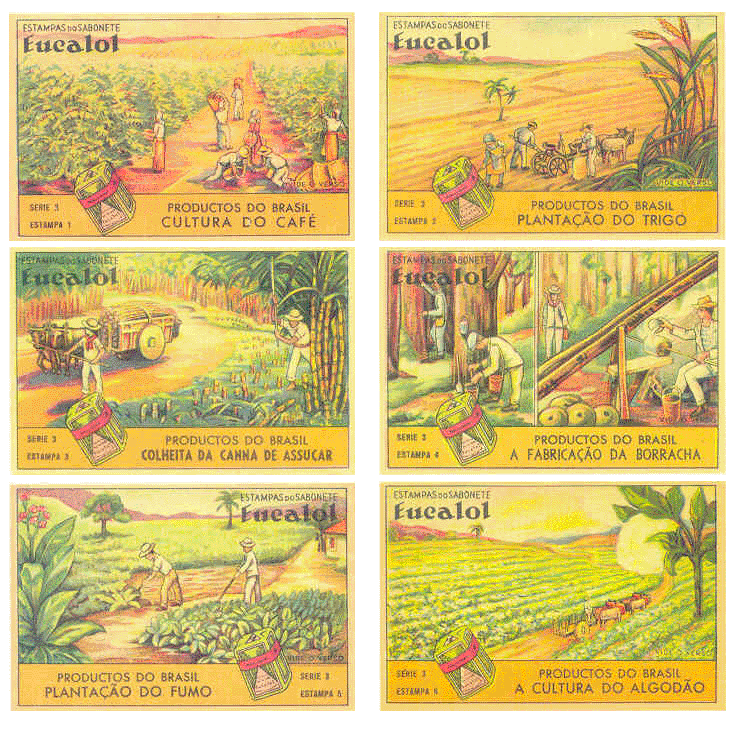
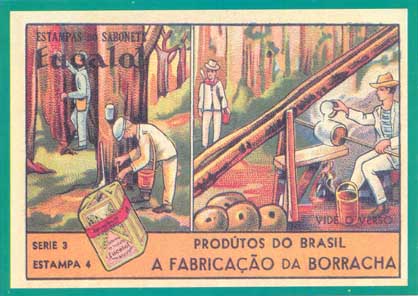
A seringueira tem o seu habitat na grande bacia amazônica. A figura representa os trabalhos de extração e preparo da borracha nas regiões do Amazonas e Pará. (Eucalol)
The Manufacture of the Rubber:
The
seringa has its habitat in the great Amazonian basin. The figure represents
the works of extraction and preparation of the rubber in the regions of
Amazon and Pará. (Eucalol)
A Borracha
A
borracha teve 2 ciclos importantes no Brasil. O primeiro no inicio do
século XX e o segundo durante a guerra mundial de 1939-1945, quando
o então Presidente Getulio Vargas convocava, em 1942, recrutas
nordestinos (batizados à época de arigós) para uma
operação de emergência que coletaria látex,
na floresta amazônica, para garantir aos EUA a matéria prima
estratégica na segunda guerra. Eles, entretanto, não tinham
a menor idéia do que era o trabalho nos seringais.
E foi assim que 30.000 arigós, enganados pelas promessas mirabolantes
de boa alimentação, amparo às suas famílias,
assistência médica e também de fama e fortuna, encontraram,
no inferno verde, dentro das terras dos patrões seringalistas,
a lei da selva, a escravidão, levando surras, chicotadas, tiros
e, finalmente, a morte.Apenas uns poucos sobreviveram a estas atrocidades.Depois
da guerra inventaram a borracha sintética.
Agora, passados 60 anos , em 2003, a Comissão da Amazônia,
na Câmara, não consegue aprovar a emenda constitucional da
deputada Vanessa Grazziotin, que concede aos seringueiros (os arigós),
conhecidos como “soldados da borracha” os mesmos direitos
concedidos aos ex-combatentes, isto é, pensão e aposentadoria
especial.(BOD)
Fonte: Informações colhidas nos artigos de Ariadne Araújo
“A batalha da Borracha”, revista Isto É de 30/12/98
e na coluna de Mauro Braga e Redação da Tribuna da Imprensa
de 29/10/03.
The Rubber
The rubber had 2 important cycles in Brazil. The first one in the beginning of century XX and as during the world-wide war of 1939-1945, when then President Getulio Vargas convoked, in 1942, conscripts northeasterns (baptized to the time of arigós) for an operation of emergency who would collect latex, in the Amazonian forest, to guarantee to U.S.A. the substance strategical cousin in the second war. They, however, did not have the lesser idea of that it was the work in you inject them. E was thus that 30,000 arigós, deceived for the ostentatious promises of good feeding, support to its families, medical assistance and also of fame and richness, had found, in the green hell, inside of lands of the rubber masters, the law of the forest, the slavery, leading beatings, lash, shots and, finally, the death. Only one few had survived to these atrocities. After the war had invented the synthetic rubber. Now, passed 60 years, in 2003, the Commission of the Amazônia, in the Chamber, does not obtain to approve the emendation constitutional of the member of the house of representatives Vanessa Grazziotin, who grants to the rubber gatherers (the arigós), known as “soldiers of the rubber” the same rights granted to the former-combatants, that is, pension and retirement especial.(BOD)
Source: Information harvested in articles of Ariadne Araújo A battle of the Rubber, magazine “Isto É” of 30/12/98 and in the column of Mauro Braga and Redação of the “Tribuna da Imprensa” of 29/10/03.
PRODUTOS
DO BRASIL
(Estampas da Série 3)