Eucalol
Série 297– "As Dansas Através do Mundo"
Texto extraído
do verso das Estampas
Das Coleções do Rio de Janeiro
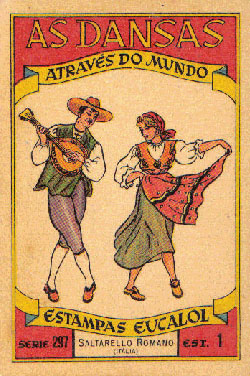
SALTARELLO
ROMANO
(Itália)
O Saltarello é atualmente a dança dos camponeses da Itália central – mas antigamente, no século XVI, era dançada com entusiasmo por toda Europa ocidental. Servia sobretudo como dança final nos bailes burgueses e camponeses.
Saltarello
ROMANO
(Italy)
The Saltarello is currently the dance of the peasants of central Italy - but back in the sixteenth century, was danced enthusiastically throughout Western Europe. Served mainly as a final dance in the dances burghers and peasants.
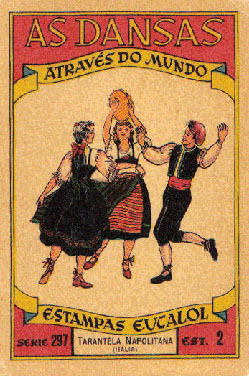
TARANTELA
NAPOLITANA
(Itália)
No
fim do século XVIII, na Itália meridional, apareceu uma
doença conhecida sob o nome de tarantismo.
Depois o tarantismo passou a ser uma dança popular ardente: a tarantela.
É uma dança de galanteio executada por um par ao som do
pandeiro. Viva e alegre, ela conservou até hoje um pouco do seu
caráter inicial.
Tarantella
NEAPOLITAN
(Italy)
At
the end of the eighteenth century in southern Italy, showed a disease
known under the name tarantismo.
After the tarantismo became a popular dance burning: a tarantella. It
is a courtship dance performed by a couple to the sound of the tambourine.
Lively and cheerful, she has kept to this day some of your initial character.
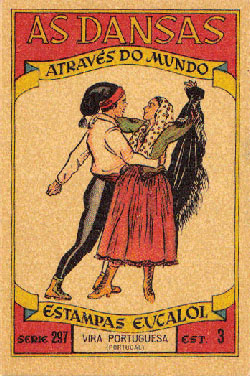
VIRA
PORTUGUESA
(Portugal)
A “vira” é a dança tradicional e típica portuguesa – é uma dança de giro que, apesar de um certo maneirismo de proveniência espanhola, possue um caráter de liberdade jovial tão comum aos portugueses. (brasilcult)
VIRA
PORTUGUESE
(Portugal)
The "flip" is the traditional dance and traditional Portuguese - is a swing dance that although a certain mannerism of Spanish origin, possesses a youthful character of freedom as common to the Portuguese.
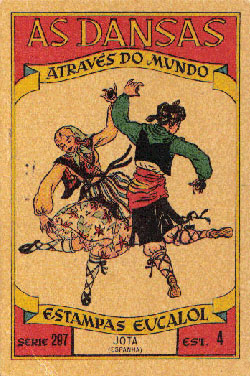
JOTA
(Espanha)
A
jota é, talvez, a dança que melhor caracteriza a arte coreográfica
da Espanha. Praticada principalmente em __________ e em Valencia, dança-se
com qualquer número de pares. O rapaz, em movimentos flexíveis
e apaixonados, mostra a sua agilidade para a moça, a qual segue
os passos numerosos e variados.
A jota é acompanhada pelo ritmo das castanholas e pelo cantor que
compõe “coplas” de toda espécie.
JOTA
(Spain)
The
jota is perhaps the best dance that characterizes the choreographic art
of Spain. Practised mainly on __________ and Valencia, dance with any
number of pairs. The boy, in love and flexible movements, shows his agility
for the girl, which follows in the footsteps numerous and varied.
The jota is accompanied by the rhythm of the castanets and the singer
who composes "couplets" of any sort.
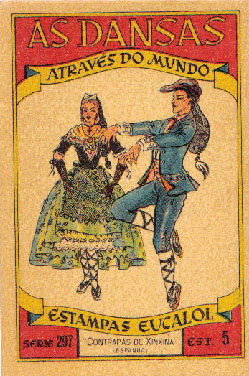
CONTRAPAS
DE XINXINA
(Espanha)
Nesta
dança da Catalunia, participam muitos pares mas o papel principal
cabe ao rapaz.
Este deve distinguir-se pela virtuosidade de seus saltos ágeis
e graciosos, ritmados pelo estalar dos dedos.
De origem religiosa o “contrapasso” é, hoje em dia,
apenas divertimento, embora que muito digno.
Countered
OF Xinxin
(Spain)
In
this dance of Catalonia, but many couples participate in the key role
is the boy.
This should be distinguished by the virtuosity of its agile leaps and
graceful, rhythmic snap of the fingers.
Religious in the "contrapasso" is, today, just fun, but it very
worthy.
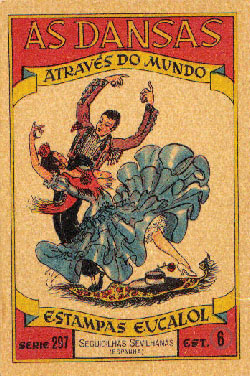
SEGUIDILHAS
SEVILHANAS
(Espanha)
A
seguidilha sevilhana é considerada a mais sedutora de todas as
danças folclóricas.
Esta dança viva e alegre de origem muito antiga é, sem dúvida,
a expressão mais perfeita da arte coreográfica popular.
Os movimentos vivos das pernas e da cabeça contrastam agradavelmente
com o movimento flexível e contínuo do torso e dos braços.
SEGUIDILHAS
Sevilhano
(Spain)
The
seguidilha Seville is considered the most seductive of all dances.
This lively and joyful dance of ancient origin, is undoubtedly the most
perfect expression of the popular art of choreography.
The lively movements of the legs and head contrasts nicely with the movement
and continuous flexible torso and arms.