Coleção: Klaus W. Gruner
Painel 14
1. Colégio
Militar – Na Instrução de Velocipedia.
2. Asilo D. Pedro V no Campo Grande (Lisboa).
3. Instituto Feminino de Educação e Trabalho.(Odivelas).
4. Collegio de Campolide – Exercícios de gymnastica sueca.
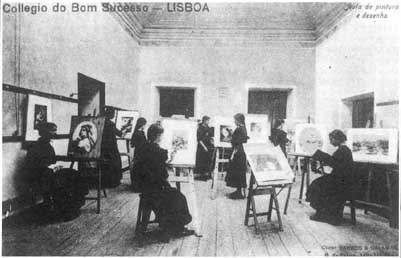
5. Collegio do Bom Sucesso – Lisboa.
6. Collegio de Campolide – Carnaval de 1903.
7. Liceu de Pedro Nunes – Laboratório de Química
– Lisboa.
8. Reformatório de S.Fiel – Refeitório.
9. Escola Industrial Marquês de Pombal. Officina de serralharia.
COLÉGIOS E INSTITUIÇÕES
Uma das grandes acusações
da República aos governos monárquicos antecedentes foi a
respeito da educação do ensino. Grandes taxas de analfabetismo,
uma rede reduzida de escolas primárias oficiais, um ensino licial
pouco criativo, uma pedagogia livresca em vez de experimental. Contudo,
se estas críticas não deixam de corresponder à verdade,
desde 1850 até 1910 tinham-se desenvolvido instituições
educativas particulares, algumas das quais se tornaram célebres
pelas suas novas técnicas educativas. Estão neste caso os
colégios jesuítas, entre os quais o de Campolide (1858-1910)
em Lisboa e o de S.Fiel em Louriçal do Campo, na Beira Baixa, e
os particulares de Lisboa, em especial o Colégio Nacional de Lisboa.
Hoje podemos ter uma noção
mais verdadeira do ensino em Portugal antes e durante a República,
em virtude das escolas, colégios e instituições assistenciais
terem editado coleções de postais sobre as suas instalações,
as suas capacidades educativas e pedagógicas e mesmo sobre sua
vida social e cultural. Podemos, por exemplo, saber qu tipo de ensino
foi ministrado na Escola Industrial Marquês de Pombal, uma das escolas-modelo
do ensino técnico-profissional, que chegou a fazer representar-se
na Exposição Naconal do Rio de Janeiro de 1908. (Marcelo del Cima)
SCHOOLS AND INSTITUTIONS
One
of the great Republican accusations against the previous Monarchic governments,
was in reference to education and teaching. The large illiteracy rate,
the small humber of public grade schools, an uncreative high school program
and a bookish pedagogy, as opposed to na experimental one were mentioned.
However, even if this
criticism was close to the truth, private educaional facilities had come
into being between the years of 1850 up to 1910, some of which became
famous fo their new educational techniques. Such is the case of the Jesuit
schools, among which we find the Campolinde (1858-1910) in Lisbon and
the S.Fiel in Louriçal do Campo, Beira Baixa, as well as the private
ones in Lisbon especially the National College of Lisbon.
We can now have a clearer
conception of teaching in Portugal today both before and during the Republic,
due to the fact that schools, colleges and assistencial institutions have
printed whole collections of postcards describing their installations,
their educational and pedagogical capacities and even their social and
cultural lives.
We can,for instance, find
out what kind of teaching was ministered at the Marques de Pombal Industrial
School-one of the model schools in the technical-professional field, and
which was even represented at the National Exposition of Rio de Janeiro
in 1908.