Coleção: Klaus W. Gruner
Painel 16
1.
O homem que pede para as almas – Quéteur.
2. Ferro Velho – Marchand de vieux habits.
3. Fadista – Un apache.
4. O limpa candieiros – Alumeur.
5. Padeiro – Marchand ambulant de pain.
6. Aguadeiro – Porteur d’eau.
7. O homem das castanhas – Marchand de marrons.
8. A varina – Marchande de poisson.
9. Marinheiro de galeota – Rameur de la brigantine royale.
10. Leiteira – Laitière.
11. Azeiteiro – Marchand d’huile d’olive.
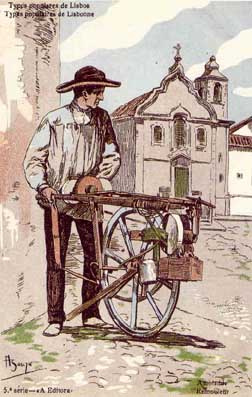
12. Amolador – Remouleur.
13. A mudança – Un déménagement.
14. Vaqueiro – Marchand de lait.
TIPOS POPULARES DE LISBOA
Várias foram
as séries de postais retratando os tipos populares de Lisboa,
publicadas em Portugal nos princípios do século. Já
no séc.XIX haviam sido editadas coleções de gravuras
abertas em cobre, madeira ou pedra, referentes às diferentes
atividades sócio-profissionais.
A série assinada
pelo aguarelista e ilustrador Alberto e Souza (1880-1961) convida-nos
a olhar para figuras típicas e hábitos sociais do quotidiano
lisboeta de 1904-1905.
Como cenários
onde circulam os tipos característicos descobrem-se aspecos da
cidade de Lisboa e dos arrabaldes, desde a Praça do Comércio
ao cais da Ribeira e do Arsenal, desde os bairros antigos Alfama e Mouraria
à Vila de Mafra. (Marcelo del Cima)
POPULAR CHARACTERS FROM LISBON
There were many series
of postcards depicting popular characters from Lisbon that were published
in Portugal at the beginning of the century. As early as the XIXth century
collections of open prints made of copper, wood or stone had been presented,
which already referred to socio-professional activities.
We are invited to look
at the typical figures and Portuguese daily life in 1904-1905 in the
series that is igned by the illustrator and water colour painter Alberto
de Souza (1888-1961).
One may discover many
aspects of the city in the scelaries of Lisbon and its outskirts as
the people are pictured circulating in places such as the Praça
do Comércio to the Pier of Ribeira na Arsenal and from the old
sections of Alfama and Mouraria to Mafra.