Coleção: Klaus W. Gruner
Painel 25
1. Os Voluntários
portugueses na guerra em França (Homenagem ao herói Raphael
Xavier de Carvalho).
2. Viva Portugal / Paz – Honra e Glória. (Homenagem à
artilharia Portugueza).
3. Por a Pátria e Liberdade / Salve Portugal (postal com. do
patriotismo e de homenagem ao Exército).
4. Viva a Pátria / Viva o Exército / Portugal (postal
com.do patriotismo e de homenagem ao Exército).
5. Guerra na Europa / Homenagem às Nações aliadas.
6. Homenagem aos Heroes / Vitória.
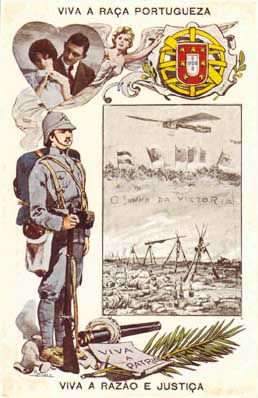
7. Viva a Raça Portugueza / Viva a Razão e Justiça
(Homenagem à Infantaria Portugueza).
8. Os Portuguezes em França – Inglezes Portuguezes condecorados.
(bilingue).
9. Os Portuguezes em França – A Missão Britânica
cumprimenta o General Rosado (bilingue).
10. Os Portuguezes em França – Damas enfermeiras da Cruz
Vermelha (bilingue).
11. Presidente Wilson – O eminente diplomata a quem se deve a
paz universal (Homenagem Portugueza).
12. Os Portuguezes em França – Evacuando civis (bilingue).
PORTUGAL E ALIADOS NA 1ª GRANDE GUERRA
A
neutralidade portuguesa nos conflitos armados internacionais tem sido
uma das grandes opções da política portuguesa. Foi
assim no tempo de D.João V, de certa maneira no tempo do Marquês
de Pombal e D. Maria I, se bem que neste reinado Portugal se viu compulsionado
a intervir nas Guerras Napoleônicas e, sobretudo, durante a monarquia
constitucional.
Durante a República
aconteceu o contrário. Em Fevereiro de 1916 Portugal entra na I
Grande Guerra a pedido insistente da Inglaterra. Em cumprimento das suas
tradições democráticas, Portugal alinhava ao lado
dos Aliados contra o Eixo.
Em Portugal, para dar
cumprimento à política de guerra, os Partidos Democrático
e Evolucionista decidiram formar a União Sagrada. Os Unionistas
de Brito Camacho e o Partido Socialita (tal como aconteceu em toda a Europa
do seu tempo) acabaram por aceitar não fazer oposição,
facto que concorreu para o aceleramento da participação
portuguesa na Guerra.
Como o exército
português havia envelhecido e se encontrava dissociado das novas
técnicas da Guerra, foi necessário fazer um esforço
de organização e de treino dos militares, gastando grandes
somas do orçamento do Estado. Formou-se um Corpo Expedicionário
Português, cujo destino era a Frente da Flandres. Chamou-se a este
esforço de preparação o Milagre de Tancos, local
onde as tropas foram treinadas.
A declaração
formal de Guerra por parte da Alemanha celerou o processo e, em inícios
de 1917, Portugal entrou na Guerra. A reportagem sistemática da
Grande Guerra levada a cabo pelo postal ilustrado dá-nos conta
do que se disse e também de alguns heróis e de muitos soldados
desconhecidos. (Marcelo del Cima)
PORTUGAL AND ITS ALLIES DURING THE 1ST. WORLD WAR
Portuguese
neutrality during international armed conflicts has been one of the great
options of Portuguese politics. Such was the case during the times of
D.João the V th., and in a certain manner, of the Marquis de Pombal
and D.Maria the 1st., although, during this reign Portugal was coerced
into interfering in the Napoleonic wars, mainly during the constitutional
monarchy.
The opposite happened
during th Republic. After insistent demands from England, Portugal joins
th 1st. World war. Meeting its democratic traditions, Portugal sided with
th Allies against the Axis.
In order to comply with
the war politics in Portugal, the Democratic and Evolutionist parties
decided to form the Sacred Union. Brito Camacho’s Unionists and
the Socialist Party, (just as it happened in all of Europe at the time),
decided at last to accept the idea of not standing in opposition, a fact
that added to the hastening of Portuguese participation in the war.
As the Portuguese army
had aged and had become distanced from the new war techniques, great effort
of organization and military training became ecessary which demanded large
sums from the State budget.
A Portuguese Expeditionary
Force was created to be sent to the front in Flandres. This great preparation
effort became known as the Miracle of Tancos, after the location where
the troops were trained.
Germany’s formal
declaration of war accelerated the process, and in 1917 Portugal entered
the war. The systematic featuring of the Great War carried through the
postcard, brings forth everything that has been said here.